Showing posts with label sex research. Show all posts

Monday, September 3, 2018

Tell Me What You Want by Justin Lehmiller: book review

"I'm scared people will find out what I masturbate to." -- Donald Glover 

Tell Me What You Want:The Science of Sexual Desire and How It Can Help You Improve Your Sex Life by Justin Lehmiller, Ph.D. is the book we've all needed, even if we didn't know it. We all have sexual fantasies, but we don't usually share them with others, even our own partners. Many of us agonize about what our fantasies say about us, or we struggle (unsuccessfully) to repress them.

What Is a Sexual Fantasy?
A sexual fantasy is any mental picture that comes to mind while you're awake that ultimately turns you on ... Simply put, a fantasy is a conscious thought that makes you feel all hot and bothered, and maybe gets some blood flowing to your genitals, too.

In this barrier-smashing book, sex researcher Lehmiller surveyed more than 4,000 Americans, ages 18 to 87, who answered 350 detailed questions about themselves, their sex lives, and their sex fantasies. The result is a solidly researched book that answers questions you probably have, such as these:
  • How common is my sex fantasy? 
  • Does my fantasy mean that I'm a bad person?
  • What sorts of people have fantasies like mine? 
  • Should I tell my partner about my fantasy?
  • What should I consider before acting out my fantasy?
  • What do other people fantasize about? 
  • What are the most common fantasies?
My biggest problem reviewing Tell Me What You Want is that it's so good that I don't know how to narrow down what I tell you about it. Look at all these Post-Its! Instead of summarizing or interpreting Lehmiller's points, here are some of them in his own words:

  • Multipartner Sex: The results of my investigation reveal that the single most popular sexual fantasy among Americans today is -- drum roll, please -- group sex ... perhaps the most normal thing there is to fantasize about because almost everyone has been turned on by the thought of it.
  • Men and women are not polar opposites when it comes to their sexual psychology ... most of the things that men fantasize about, women fantasize about as well.
  • Our sexual fantasies appear to be carefully designed to meet our psychological needs -- and because those needs change and evolve over our life span, it seems that our sexual fantasies naturally adjust in order to accommodate them. 
  • There's a world of difference when it comes to what turns someone on at [different] life stages ... older adults -- especially those in long-term, monogamous relationships -- are more likely to crave something fresh and new ... like an orgy or an open relationship.
  • According to my survey data, if there's one specific person who's likely to appear in your sexual fantasies, it's your current romantic partner.
  • When we feel ashamed or guilty about what turns us on, it can potentially lead to sexual performance difficulties ... the more negative emotions [survey participants] reported -- things like guilt, shame, embarrassment, fear, anxiety, and disgust -- the more sexual problems they had. 
  • When the novelty of a new relationship has worn off, adding new and exciting elements to your sex life by acting on your fantasies can potentially prevent passion from subsiding and allow it to keep burning.

There's more, so much more. Whether you're interested in the world of sex research, or you just want to understand your own sex fantasies better, or you're looking for tips for communicating better with your partner, I know you'll enjoy and learn from Tell Me What You Want:The Science of Sexual Desire and How It Can Help You Improve Your Sex Life, as I did.


Justin Lehmiller and I had a conversation about senior sex recently:

Saturday, September 1, 2018

"Sex after 65" in the news


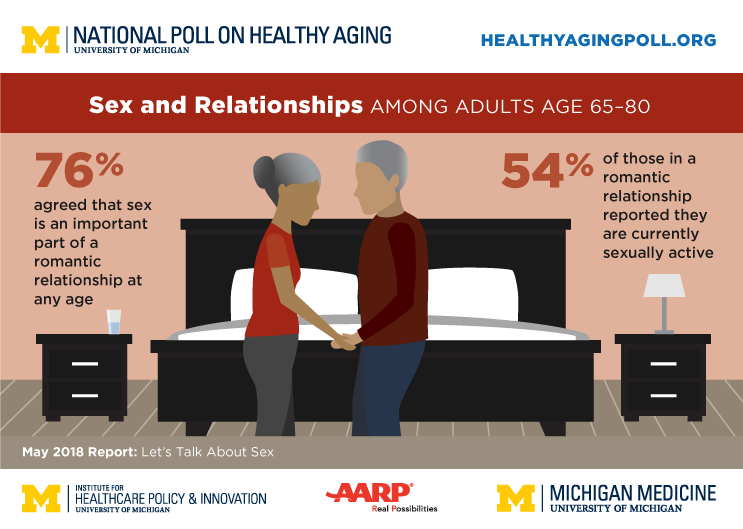
I'm often complaining that little is known about our age group's sexual behavior and beliefs because no one asks us. So I was delighted to learn that researchers at the University of Michigan surveyed 1,002 people between 65 and 80 about their sex lives as part of the National Poll on Healthy Aging 2018. The report, titled "Sex after 65. Health, gender differences, and lack of communication," was released on May 3, 2018.

Here are some of the findings:
  • 40 percent of people between the ages of 65 and 80 are sexually active.
  • 54 percent of those with a partner are sexually active.
  • Nearly 2/3 of older adults say they’re interested in sex.
  • More than 50% say sex is important to their quality of life.
  • 73 percent said they are satisfied with their current sex life.
  • 18 percent of older men and 3 percent of older women say they’ve taken medications or supplements to improve sexual function in the past two years.
  • Only 17 percent of older adults said they have talked with their doctor or other health care provider about sexual health in the past two years.
  • Those between the ages of 65 and 70 were nearly twice as likely as those in their late 70s to be sexually active.
  • 50% of men but just 12 percent of women aged 65 to 80 said they were extremely or very interested in sex.

As I read this, I kept asking myself how they defined sex or sexually active or sex lives. Did sex with a vibrator, a partner's hand or mouth, or one's own hand count as sexually active or having a sex life? (I say yes.)  I asked Erica Solway, Ph.D., co-associate director of the poll, who told me,

We did not define sex because we wanted the response to be based on the individual’s definition of what constitutes sex (or their sex life or being sexually active) from their own perspective. We felt this was important, but it does mean that we do not have information on what activities people were referring to when they reported they were or were not sexually active. It’s possible that two people engaged in the same activities may have responded to the questions differently based on their personal definition.

I agree that our own definition of what constitutes sex is important in a study like this -- I applaud this, in fact. But I would have liked that clearer in the poll questions. For example, "Are you currently sexually active?" could have been worded, "Do you engage in sexual activity?" That may sound almost the same, but I have a hunch that many people would interpret the first question as "Do you have sex with a partner?" and the second as "Do you have sex, either with a partner or with yourself?" Asking the question differently would have raised the percentage of people who answered yes to that question, seems to me.
May, Graphic 1
What do you think, readers? Am I off base? How would you interpret the question, "Are you currently sexually active?" (Please answer in the comments section.)

The wording of the questions is a minor quibble, though, because I understand that the poll was multiple-choice, not essay questions, and answered online, not via an interview. In the end, I'm happy that someone's asking.

This report was all over the news. Here are some of the headlines:
As glad as I was to see this study in the news, I couldn't help wondering why the [younger] public is so surprised that we seniors have sex on our minds and in our beds. Why would we give up something so pleasurable? Do they expect that on some predetermined birthday, we'll just say, "Sex? Been there, done that, moving on. Now help me blow out all these candles."

Thank you, University of Michigan Institute for Healthcare Policy and Innovation, for conducting the study, and AARP and Michigan Medicine, U-M’s academic medical center, for sponsoring it. Let's keep talking.

Monday, June 19, 2017

Why Don't They Ask Us?


I'm sure you've seen news stories that announce how often seniors are having sex or how much we enjoy the sex we're having. A problem I have with many of the studies about sex and aging is that they often don’t define “having sex.”

Does "having sex" mean partnered sex only? (Solo sex is real sex!) Heterosexual intercourse only? Orgasms? Are they asking whether we're having the same kind of sex we used to? What if we're enjoying new ways of having sex?

If we give a partner an orgasm and the partner gives us an orgasm, but there's no PIV (penis in vagina), did we have sex? I say yes. If we haven't had partner sex for a year but we give ourselves weekly orgasms with our favorite vibrator, are we sexually active? I say yes.

I don’t think we know much about what kind of sex seniors are having, once we broaden the definition of what sex is. My definition: Sex is any activity, solo or partnered, that gives us sexual pleasure, arousal, orgasm -- and maybe, but not always, all three. Does that cover the kind of sex you're having? Help me finesse this definition.

Let's discuss this. How would you define sex at our age? And how has your definition of sex changed over the decades? If you're willing to share your definition, or you have a comment on this topic, I invite you to post to the comments section. Your turn!


Tuesday, January 3, 2017

Senior Sex Research: Here's what I'd like to know

When I started writing about senior sex in 2005, it was difficult to find studies about sex and aging. It's somewhat better now, though still limited. Researchers are more open to including our age group, but I wonder if they're asking the right questions.

I'm not looking for statistics, such as how many of us are having sex. Doesn't that depend on (a) how the researchers and the subjects define "having sex" and (b) whether we have what we need (partner, privacy, physical ability, emotional intimacy) to have the kind of sex we want?

I'd like to see research into how we think about sex now, what determines quality of sex, what's missing in our sexual worlds, what we're learning about sex and about ourselves during our later years.

So while we're waiting for the right research to be done, here are some questions for you if you're over 50, 60, 70 and beyond:

1. If a researcher asked if you are "sexually active," how would you answer? What would you mean by that answer?

2. How has the definition of "what is sex?" changed or evolved for you over time? What did it used to mean? What does it mean now? What made your definition change (if it changed)?

3. If you could be in any kind of sexual relationship you wanted, what would it be? Never mind how you might be judged -- what would be ideal for the real you, maybe the secret you?

4. What would you like to tell our society about sex and aging?


I asked the good folks who follow my Naked at Our Age Facebook page, "If researchers wandered over here to learn what studies we'd like to see conducted about sex and aging, what would you suggest?" Here are some of their suggestions:

  • Studies toward normalizing serial monogamous relationships. As we age, the chances are that we will lose our partner. When that happens, it should be easier to establish new relationships without feeling that we are betraying the partner who has died. We don't have to give up our former love in order to love another person. I think we can keep the truth and warmth of the past love, have an additional love or two, without feeling that we have violated the truth of the first. 
  • I'd love to see more of an in-depth study on how illness/ disability/ aging affect our sexuality and sex lives.
  • How about a serious, non-judgmental look at the multi-faceted, complicated reasons for diminished libido as we age? (hormonal, psychological, physiological) Why it affects some and not others and methods - again multi-faceted - for those who indeed want to revitalize their libido.
  • Can ingrained sexual scripts be changed enough so that new ways of "having sex" aren't seen as less satisfying than former ways? 
  • What is the most effective way to help older adults get on board with safer sex? 
  • The best ways to empower older adults to set, communicate, and respect sexual boundaries.
  • I'm fascinated by what seems to be a growing popularity of open marriages or open relationships in the over 50 crowd. Is this just anecdotal or have others noticed it too? 
  • Re-defining what "satisfying sex" is to align better with how bodies change with age. This could go hand-in-hand with the ever-popular yet hardly discussed question, "What is sex?" It can be so many things. 
  • Seniors discovering and accepting polyamory.

I'm eager to hear from you, whether you'd like to answer one of my questions or add to the list of what researchers should study. Please post a comment and include your real age. You can choose any name you want when you comment, so be creative and please choose something other than "Anonymous"! (Choose "Name/URL" from the comment drop-down menu. You can then type the name of your choice, and you do not need to include a URL.)

Let's keep talking. The conversation has just begun!


P.S. When I invite you to comment, I'm inviting you -- real people -- to share your personal views. I'm not inviting ads for escort services, ED "cures," porn sites, or other commercial enterprises. And I don't need to be told to repent -- not gonna happen. I shouldn't have to say any of this, but the number of comments I have to delete indicates otherwise. [I know, the trolls and robots aren't even reading this, but I have to try.]  

Tuesday, March 1, 2016

Seniors: How (and what) is your sex life?

It occurs to me that after 11 years of talking out loud (shouting, insisting, cajoling, writing) about senior sex, the questions that interviewers ask me have become quite intelligent and open-minded.

When I first started this work, interviewers would ask elementary questions (e.g. "Is it true that seniors are having sex?") and would often place a value judgement on what they heard (e.g. "Yeah, but eeuuww, the idea of my parents/grandparents having sex...!")

But now, however young the interviewer is, there's an open attitude, a nonjudgmental striving to understand. It's not such an odd idea anymore that we aren't retiring our genitals at some arbitrary age. This is progress! Or am I just lucky enough to be interviewed by smarter, more sex-positive interviewers?

One topic that interviewers find endlessly fascinating is that we're not settling into old age passively or predictably. Many of us decide that it's time to go after what we want, whether or not it's what we used to want or ever thought we'd want.

I wrote about this in the "Stretching Boundaries" chapter of  The Ultimate Guide to Sex after 50, and many of you contributed your experiences in the "Off the Beaten Path: Nontraditional Sex Practices and Relationships" in Naked at Our Age. I'm often asked, "What percentage of seniors are into kink?" or "Are many seniors polyamorous?" or "Are most seniors happier with their sex lives than they were when they were young?" I sometimes answer, "I don't collect statistics -- I collect stories."

Yes, some studies have been done, but more often than not, research and surveys either overlook our generation entirely or only study straight relationships and define sex as heterosexual intercourse, which is just one form of sexual expression. I don't think that our generation is being asked the right questions about what we do, what we want, and how we feel about it.

So I'm opening this up to you: If you're over 50 (lots older is fine!) and you find that your ideas have changed about what you want your sex life to be, please feel free to comment with your views and especially how those views have changed in recent years. Please give yourself a first name (doesn't have to be real) instead of "Anonymous" and include your real age. (If you have any trouble posting a comment, email me with the subject line "blog comment: how and what" and include what you want to say, what name you want to use, and your age, and I'll post it for you.)

I started this discussion on my Naked at Our Age Facebook page, which I hope you'll read, "like," and share. Thanks!


Learn more about my most recent book, The Ultimate Guide to Sex after 50. Order here for an autographed copy, purchase from your local independent bookstore, or order from Amazon.

Ultimate Guide to Sex After 50


Wednesday, November 26, 2014

For More Senior Sex News and Views...

A new book coming out in January... regular Sex At Our Age articles for Senior Planet... speaking gigs all over the country... a gazillion yet-to-be-answered emails from readers -- with all that's going on, you may notice gaps of two weeks or more between posts.

That doesn't mean that I'm ignoring my mission to keep the conversation going about boomer and older-age sexuality -- quite the contrary! I'm using my Naked at Our Age Facebook page to give you quick senior sex news and views and links to articles of interest to sex-positive seniors. You'll also find questions I'd love to hear you discuss and occasional rants from me.

Here are some of the topics we've been discussing there:

  • Single seniors: What has made you cringe that you've viewed or read on a dating profile?
  • The lack of older adults in sexuality research.
  • What does your favorite porn say about you?
  • Men try sex toys for the first time video -- our guys grumble about the message.
  • Sex blogger Erica Jagger's gynecologist says sex ends for women at 65.
  • A midlife man talks about his body and posing nude.
  • A Danish magazine interviews me about sex toys for seniors.

If you're not following my Naked at Our Age Facebook page yet, visit the page, "like" it, comment on anything that grabs you, and visit often.

Don't assume that you'll automatically see that page in your news feed, even after you've "liked" it, though. Only a small percentage of the page's followers do, because Facebook wants to encourage (strong arm) me to pay to promote the page. You can circumvent that problem by doing this:

  1. Go to my Naked at Our Age Facebook page.
  2. "Like" it if you haven't already.
  3. Hover your cursor over the "liked" button to get a drop-down menu. Click "get notifications." 

Aha, now you'll  receive a notification from Facebook every time I update the page. (Thank you, Eva Gantz of Giving Books a Voice: Helping authors get smart about social media, for explaining this to me.)

Yes, I'll continue to write this blog with topics that need more length and depth than a Facebook update allows. In fact, I have about five different posts in the hopper that I need to finish. Meanwhile, see you on Facebook?